- Free Consultation: (217) 544-4057 Tap Here To Call Us









Common Mistakes Police Make in Field Sobriety Tests and How We Use Them


Last Reviewed & Updated: September 20, 2026
By: W. Scott Hanken | Former Sangamon County Prosecutor | Springfield Criminal Defense & DUI Attorney | Voted “Best Attorney” — Illinois Times Best of Springfield & State Journal-Register Reader’s Choice | Springfield, IL | Sangamon County | (217) 544-4057 | hankenlaw.com
Bottom Line: Field sobriety tests are only as good as the officer who administers them and the ground you were standing on. When the procedure breaks down, the “clues” stop meaning anything — and in Illinois, one of the three tests has its own rulebook that most people have never heard of.
You were pulled over on I-55, on Veterans Parkway, or near the Illinois State Fairgrounds. An officer asked you to follow a pen with your eyes, walk a line you couldn’t see, and stand on one leg on a sloped gravel shoulder at 1:00 a.m. Then you were in handcuffs, and the report said you “failed.”
Here is what that report usually doesn’t say: whether the officer gave the instructions the way he was trained to, whether the surface met the standard, whether he checked for the medical conditions he was supposed to rule out first, and whether any of it was recorded.
What the Standardized Field Sobriety Tests Actually Are
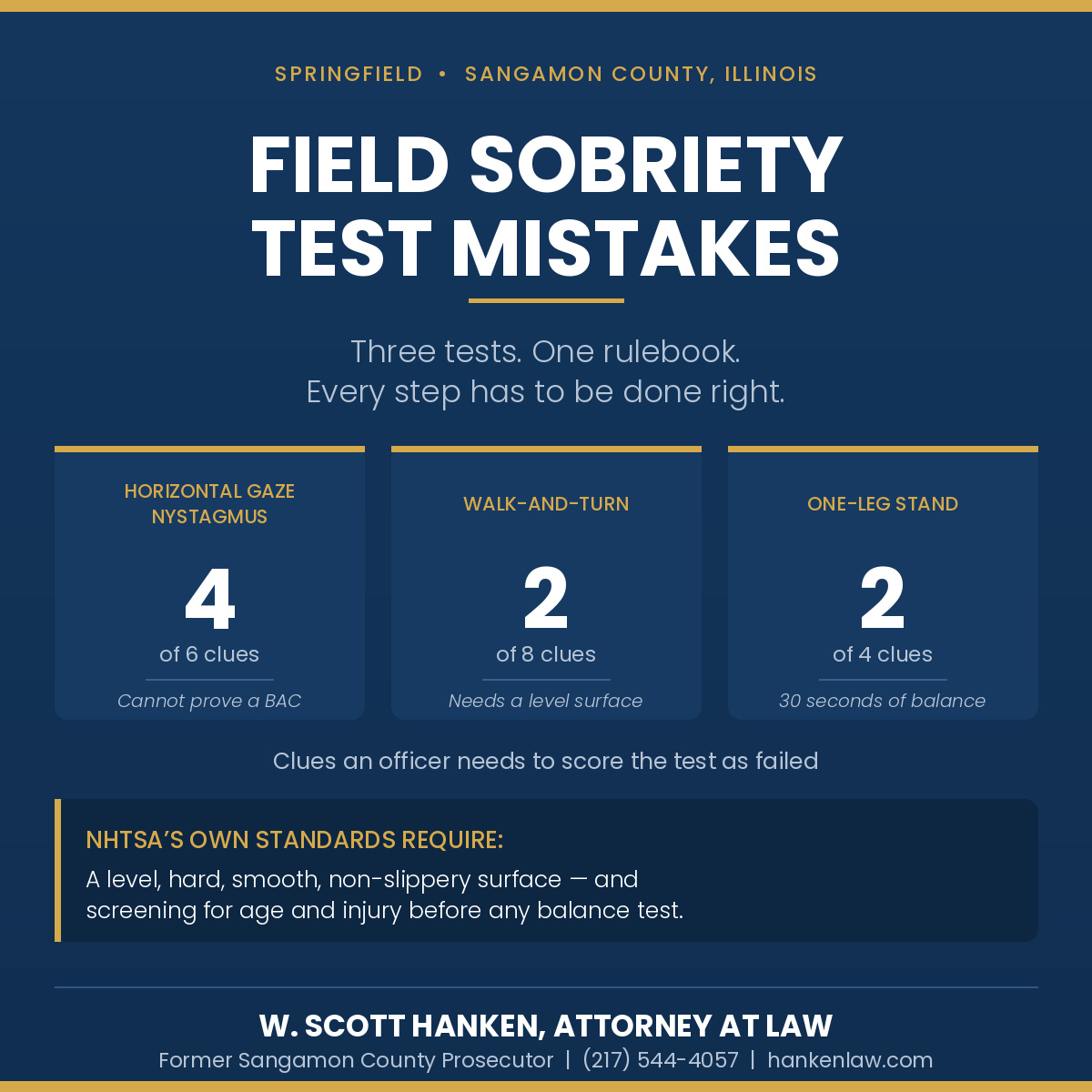
There are three, and only three, tests in the standardized battery developed under the National Highway Traffic Safety Administration (NHTSA) curriculum:
- Horizontal Gaze Nystagmus (HGN) — the “follow my finger” eye test
- Walk-and-Turn (WAT) — nine heel-to-toe steps out, a specific turn, nine back
- One-Leg Stand (OLS) — one foot raised roughly six inches, counting aloud for 30 seconds
Anything else you were asked to do — recite the alphabet from D to R, count backward from 67, touch finger to nose, tilt your head back — is a non-standardized exercise. It has no validation study behind it and no scoring standard. It is the officer’s opinion of your performance, nothing more.
The word “standardized” is doing real work here. These tests were never designed to prove impairment. They were designed to help an officer decide whether to arrest. The most-cited validation research, the 1998 San Diego field study by Stuster and Burns, reported officer decision accuracy of roughly 88% using HGN, 79% using the Walk-and-Turn, and 83% using the One-Leg Stand, with about 91% for the three combined.
Officers quote those numbers in court constantly. Three things travel with them that rarely make it to the jury:
- They measure whether an officer correctly estimated whether a driver was above or below a BAC threshold — not whether the driver was actually impaired, and not whether the driver was guilty of anything.
- The average BAC of arrested drivers in that study was roughly 0.15 — nearly double the legal limit. The study says very little about the 0.08-to-0.12 range where real cases are actually fought.
- The accuracy claim is expressly conditioned on the tests being given exactly as standardized. Change the instructions, the surface, the scoring, or who you give them to, and the number stops applying.
That third point is the whole ballgame.
The HGN Test: Illinois Has Its Own Rulebook
The HGN test looks for involuntary jerking of the eye as it tracks a stimulus to the side. Because it is presented as scientific evidence rather than ordinary observation, Illinois treats it differently from the other two tests.
In People v. McKown, 236 Ill. 2d 278 (2010), the Illinois Supreme Court held that HGN evidence is admissible under the Frye standard — but drew hard lines around it. Under McKown:
- HGN is evidence of alcohol consumption and possible impairment. It is not proof of actual impairment.
- HGN cannot be used to establish a specific alcohol concentration, or to suggest a driver was over 0.08.
- The State must lay a foundation showing the officer was trained to NHTSA standards and administered the test in accordance with the NHTSA protocol.
- Even with that foundation, a trial court can still exclude HGN where its prejudicial effect outweighs its probative value.
The defendant’s conviction in McKown was reversed precisely because the State never established that the officer performed the test correctly.
Where HGN goes wrong in the field:
| The requirement | The common failure |
|---|---|
| Check for equal pupil size, equal tracking, and resting nystagmus first | Skipped entirely — the officer goes straight to the passes |
| Stimulus held 12–15 inches from the nose, slightly above eye level | Held too close, causing the eyes to converge |
| Each pass timed to a specified count | Rushed — the officer sweeps too fast to observe anything reliable |
| Subject’s head kept still, eyes doing the tracking | Subject turns his head; no correction given |
| Subject positioned away from rotating squad lights | Tested facing strobing emergency lights |
Nystagmus also has dozens of causes that have nothing to do with alcohol — including certain medications, fatigue, head injury, inner-ear conditions, and congenital nystagmus. An officer who never asked about any of them cannot rule them out afterward.
One correction worth understanding: when HGN is admitted without a proper foundation, that is an evidentiary error. The remedy is a motion in limine or a trial objection, not a motion to suppress. Suppression is a different tool for a different problem — see below.
The Walk-and-Turn: When the Road Creates the “Clues”
The Walk-and-Turn has two phases, and the officer is scoring you in both. Two or more clues out of eight is the threshold.
NHTSA’s own manual calls for the test to be conducted on a surface that is level, hard, smooth, and non-slippery, with a designated straight line and adequate lighting. Central Illinois roadsides frequently supply none of those.
Mistakes that show up in Sangamon County cases:
- Sloped or crowned pavement. Every road is crowned for drainage. A shoulder is worse. Swaying on a slope is physics, not alcohol.
- Gravel, ice, snow, rain, or standing water. Each of these produces the exact clues the officer is counting.
- No real line. If the officer says “just imagine a line,” the balance task and the step-off scoring both become guesswork.
- Footwear. NHTSA calls for offering subjects in heels over two inches the chance to remove their shoes. Work boots, dress shoes, and flip-flops all change the result.
- Instruction-phase clues scored from botched instructions. Two of the eight clues come from the instruction stance alone. If the officer never told you to hold the position and not to begin until told, he cannot score you for breaking it.
- Wind and passing traffic on I-55 or Dirksen Parkway. A semi passing at 70 miles per hour moves a person standing heel-to-toe.
One thing the draft version of this article got wrong, and worth correcting: the “50 pounds overweight” caution in the NHTSA research attaches to the One-Leg Stand, not the Walk-and-Turn. Overstating that on cross-examination hands the prosecutor an easy win.
The One-Leg Stand: The People Who Shouldn’t Have Been Asked
The One-Leg Stand is scored on four clues — swaying, using arms for balance, hopping, and putting the foot down. Two clues is the threshold. Two out of four is a narrow margin for a person standing on a dark shoulder in front of an armed officer.
NHTSA’s original research noted that certain people had difficulty with this test regardless of alcohol:
- Individuals over 65 years of age
- People with back, leg, or inner-ear problems
- People who are 50 or more pounds overweight
Note the precise claim. NHTSA does not say these people are automatically “passing” or that the test is void. It says the validation research does not cover them, and that they can be expected to struggle. That is a real and defensible point — and it only works if the officer never asked. A trained officer is supposed to inquire about physical limitations before administering a balance test. Many never do, and the omission is right there in the video.
Anxiety, exhaustion, a long shift, cold weather, and prescription medication all belong in the same category.
Field Sobriety Tests Are Voluntary in Illinois. The Chemical Test Is Not.
This is the single most misunderstood point in Illinois DUI law, and it costs people cases.
Illinois’s implied-consent statute, 625 ILCS 5/11-501.1, says that by driving on Illinois roads you consent to a chemical test of blood, breath, other bodily substance, or urine after a lawful DUI arrest. That is the full scope of the statute. It does not reach roadside balance exercises.
What that means in practice:
- Refusing the roadside tests carries no statutory summary suspension and no separate charge.
- Refusing the post-arrest chemical test does trigger a suspension — 12 months for a first offender, and refusal evidence is admissible against you under 625 ILCS 5/11-501.2(c)(1).
- An officer is not required to tell you the roadside tests are optional, and most don’t.
- Declining does not prevent an arrest. If the officer has probable cause from driving behavior, odor, speech, and appearance, you are going in regardless.
- A prosecutor may argue that declining shows consciousness of guilt. That argument is answerable — by the fact that declining is lawful, by any medical or physical reason you had, and by the video.
Statute Callout — the portable breath test cuts one way, and it isn’t the State’s way. Under 625 ILCS 5/11-501.5, the roadside PBT may be requested on reasonable suspicion, you may refuse it, and the result is used by the officer to decide whether to request a chemical test. The statute then says the PBT result may be used by the defendant as evidence in a DUI or summary-suspension proceeding. The State does not get to use it to prove guilt. If your roadside number was low, that number belongs to your defense.
What Happens After the Arrest: The 46-Day Clock
Two cases open the night you are arrested, and they run on separate tracks.
The criminal case — the Class A misdemeanor (or felony) DUI charge under 625 ILCS 5/11-501, heard in the Seventh Judicial Circuit at the Sangamon County Complex, 200 S. 9th St., Springfield.
The license case — the statutory summary suspension, a civil administrative action run by the Secretary of State. It happens whether or not you are ever convicted.
Here is the timeline that matters:
| Day | What happens |
|---|---|
| Day 0 | Officer serves the Notice of Statutory Summary Suspension, confiscates your license, and issues a receipt permitting you to drive |
| Days 1–45 | You may keep driving on that receipt |
| Day 46 | The suspension takes effect — 6 months for a failed chemical test, 12 months for a refusal (first offender) |
| Within 90 days of the notice | Deadline to file a Petition to Rescind Statutory Summary Suspension in the circuit court of venue |
| Within 30 days of filing | The statute requires the hearing to be conducted |
Two things about that 90-day window that the standard explanation leaves out.
First, 90 days is the outer limit, not the target. Filing the petition does not stay the suspension — 625 ILCS 5/2-118.1(b) says so expressly. If you wait 80 days to file, you serve the suspension while you wait for a hearing. The petition needs to be filed early enough that the hearing lands before Day 46.
Second, the hearing’s scope is narrow. The court is limited to four questions: whether you were properly placed under arrest for DUI; whether the officer had reasonable grounds to believe you were driving under the influence; whether, after being warned, you refused testing; and whether, after being warned, you submitted to testing that showed 0.08 or more. It is not a trial on guilt. It is, however, a sworn evidentiary hearing where the arresting officer can be subpoenaed and cross-examined under oath — months before the criminal trial, on a record that follows him into that trial.
That is why the petition matters even in cases where rescission is a long shot.
The 0.05 BAC Bill: What HB 4333 Would Actually Do
You may have seen coverage of a proposal to lower Illinois’s limit from 0.08 to 0.05. Here is the accurate picture as of September 2026.
House Bill 4333, filed January 7, 2026 by Rep. Daniel Didech, would replace 0.08 with 0.05 as the presumptive limit throughout the Illinois Vehicle Code — and in the Snowmobile Registration and Safety Act, the Boat Registration and Safety Act, and the Workers’ Compensation Act. Utah is currently the only state at 0.05.
The bill has not passed. It was assigned to the House Judiciary–Criminal Committee in February 2026, re-referred to the Rules Committee under Rule 19(a) in March, and has not advanced since, though it has continued to pick up co-sponsors. The legal limit in Illinois remains 0.08.
But here is the point that gets lost in the coverage, and it matters far more to your case than a stalled bill:
You can already be prosecuted below 0.08. Under 625 ILCS 5/11-501.2(b), the presumptions work in three tiers:
| Alcohol concentration | Legal effect |
|---|---|
| 0.05 or less | Presumed not under the influence |
| More than 0.05, less than 0.08 | No presumption either way — the reading may be considered alongside other competent evidence |
| 0.08 or more | Presumed under the influence |
That middle tier is where flawed field sobriety evidence does its real damage. A driver who blows 0.06 is not presumed impaired — but if the officer’s report says six of six HGN clues, five of eight Walk-and-Turn clues, and three of four One-Leg Stand clues, the State will build its entire case on those numbers. Dismantling them is the case.
How We Attack Field Sobriety Evidence
The video against the report. Squad-car and body-worn camera footage is the most useful evidence in most DUI files, and it is routinely inconsistent with the narrative written hours later. We compare the officer’s verbal instructions against the NHTSA script word by word, time the HGN passes, look at what the ground actually looked like, and watch how you walked to the back of the car before any test began. Footage retention windows are short. This is the first thing we request.
The officer’s training file. McKown requires proof that the officer was trained to the NHTSA standard. Certification dates, refresher records, and the curriculum actually completed are all discoverable, and they are not always what the testimony assumes.
The breath instrument’s records. If you gave an evidentiary breath sample, Illinois State Police regulations govern the machine and the procedure. Under 20 Ill. Adm. Code 1286.310(a), the operator must continuously observe you for at least 20 minutes before the test, during which you must be deprived of alcohol and foreign substances and must not have vomited. Under 20 Ill. Adm. Code 1286.230, the instrument must be checked for continued accuracy at least once every 62 days. The regulations also set the subpoena window: records from 62 days before your arrest through 62 days after.
Those are not technicalities. In People v. Clairmont, 2011 IL App (2d) 100924, breath test results were barred where the gap between accuracy checks exceeded 62 days. Noncompliance with the statute and the regulations renders results unreliable and inadmissible.
The stop itself. If the initial stop or the arrest violated the Fourth Amendment, everything that followed — including the breath result — is subject to suppression as fruit of the poisonous tree. This is where a motion to quash arrest and suppress evidence belongs. Debunking the field sobriety tests is often how the probable-cause showing collapses.
Local knowledge. DUI arrests in Sangamon County come from Springfield Police, the Sangamon County Sheriff’s Office, and Illinois State Police Troop 6, which is headquartered in Springfield and covers Sangamon along with eleven surrounding counties. Each agency has its own report formats, camera systems, and testing locations. Knowing which records exist and where to ask for them is half of getting them.
Frequently Asked Questions (FAQs)
The breath result is not the end of the analysis. If the arrest was made without probable cause, the breath result can be suppressed as fruit of an unlawful arrest — and the field sobriety tests are usually the foundation of that probable-cause showing. Separately, the result itself can be challenged on regulatory grounds: a missed 20-minute observation period or an accuracy-check gap beyond 62 days can keep the number out entirely. Whether either applies depends on the specific record in your case.
Nothing automatic. Illinois’s implied-consent statute covers chemical testing after arrest, not roadside balance exercises. Refusing the roadside tests carries no license suspension and no separate charge. You can still be arrested if the officer has probable cause from other observations, and a prosecutor may argue your refusal showed consciousness of guilt. The State is then left proving impairment from the officer’s subjective observations alone — which is a harder case for them and a better one for you.
That is different. A first-offender refusal triggers a 12-month statutory summary suspension, compared to 6 months for a failed test, and the refusal itself is admissible evidence under 625 ILCS 5/11-501.2(c)(1). The trade-off is that the State has no BAC number to put in front of a jury.
You have 90 days from the date the Notice of Statutory Summary Suspension was served to file a Petition to Rescind. But the suspension takes effect on Day 46 and filing does not pause it — so the practical deadline is far earlier than 90 days. Call as soon as you can.
No. Under People v. McKown, HGN is admissible only as evidence of alcohol consumption and possible impairment. It cannot be used to prove actual impairment, and it cannot be used to establish or suggest a specific alcohol concentration. If an officer testifies beyond those limits, that testimony is objectionable.
Not in every circumstance, and practices vary by agency and equipment. When footage exists, it is usually the most valuable evidence in the file — and retention periods are short. If you have been arrested, the request needs to go out early.
It can matter a great deal, particularly on the One-Leg Stand. NHTSA’s research flagged that people over 65, people with back, leg, or inner-ear problems, and people 50 or more pounds overweight had difficulty with these tests independent of alcohol. A trained officer is supposed to ask about physical limitations before administering a balance test. If yours didn’t, that omission is usually visible on the video.
Not as of September 2026. House Bill 4333 would make that change, but it has not advanced out of committee and the limit remains 0.08. Note that under existing law, a reading above 0.05 but below 0.08 creates no presumption in either direction — the State can still prosecute using other evidence, which is exactly why flawed field sobriety evidence matters so much in borderline cases.
Further Reading
Practice Area
Related Articles
- Illinois DUI Breath Test Myths: Silence Beats Tricks — the roadside tests are only stage one; this covers what happens at the station and why the internet’s workarounds don’t work.
- DUI Dismissal in Illinois: What Actually Gets Cases Dropped — if you want to know what a flawed field sobriety test can realistically produce, start here.
- The Tony Romo DUI Video: What It Really Teaches Springfield Drivers About Their Rights — a real roadside encounter, broken down frame by frame.
- What to Do During a Traffic Stop in Illinois: A Step-by-Step Guide — the decisions that happen before any test is offered.
- Flashing Lights in Your Rear-view: Illinois DUI Checkpoints, Stops & What to Do in 2026 — checkpoints work under different rules than a routine stop.
Browse by Topic
Ready to Fight Your DUI Charge in Springfield?
Call W. Scott Hanken at (217) 544-4057 or contact us online for a free consultation. We serve clients throughout Springfield, Sangamon County, and Central Illinois.
About the Author: W. Scott Hanken, Attorney at Law
Scott Hanken is a Springfield, Illinois criminal defense attorney with over 37 years of experience, including service as a former Sangamon County prosecutor. He has been voted Best Attorney by the Illinois Times and State Journal-Register, holds an Avvo 10.0 “Superb” rating, and has earned over 270 five-star Google reviews. He serves clients throughout Sangamon County and Central Illinois.
📍 1100 S 5th St, Springfield, IL 62703 | ☎ (217) 544-4057 | 🌐 hankenlaw.com
This article is for general educational purposes only and does not constitute legal advice. Every case is unique — contact an experienced Springfield criminal defense attorney for guidance on your specific situation.

Address
Our offices are located at the corner of South Fifth Street and Vine, in the historic Mary Bryant Home for the Blind.